How does consumption shaping work?
Last updated: April 2, 2026
The shaping process measures how a pattern of electricity consumption aligns with market price movements over time.
Load weightings are calculated to show whether usage during each period tends to be higher or lower than the average, highlighting how a customer’s demand shape differs from a flat load.
These weightings are applied to the hourly or daily forward prices to produce a shaped price — the effective cost of supplying that specific usage profile. These output prices are unique to the customer.
How are load weightings calculated?
Step 1: Rating
In order to calculate a load weighting, we first need to rate the customer's consumption data against a given price index. The rating process receives three key inputs:
Customer's consumption
The price index
The forward price time of use definitions (e.g. temporal expressions). These define for example, what Peak hours are vs. what Off Peak hours are.
The rating process outputs a wide range of data, however the shaping process is interested in the following (example below is for Peak and Off Peak):
Total Peak Value
Total Peak Volume
Average Peak Price
Total Off Peak Value
Total Off Peak Volume
Average Off Peak Price
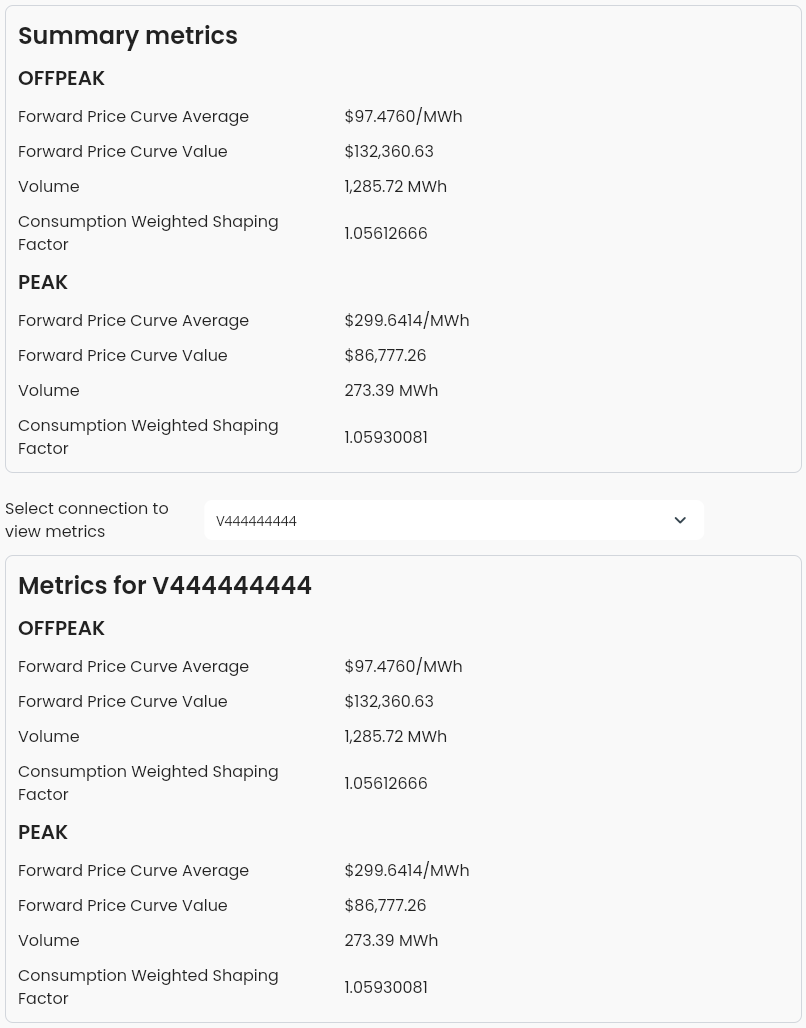
Where multiple connections are provided into a quoting process Factor will aggregate this data for all sites to produce summary metrics, in the same format which represent the values for all sites.
Both summary and site metrics are shown on the final quote output:
Step 2: Calculate Loadings
Load weightings are calculated as follows, where VWA = Volume Weighted Average and p represents a partition (a time of use definition).
