Understanding Rate Sets and their purpose
Last updated: March 20, 2026
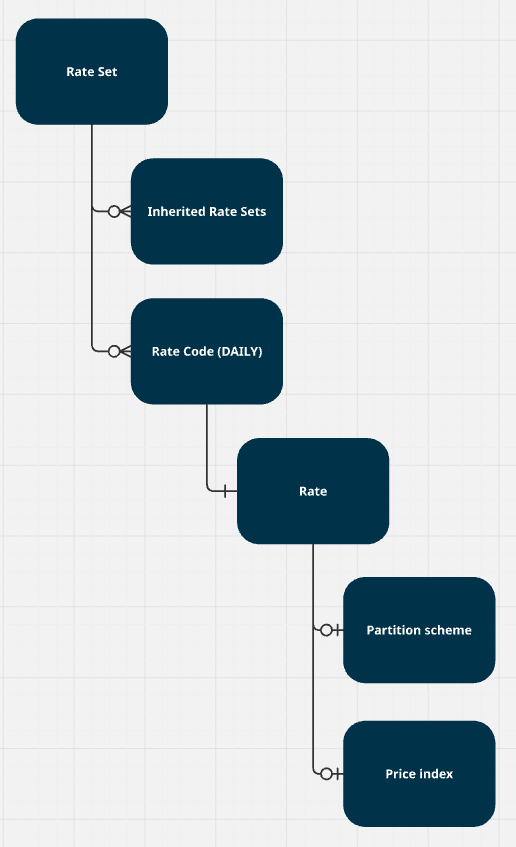
Rate Sets are where multiple prices can be combined into logical groups. Rates are comprised Rate Codes. Rate sets may define other rate sets to inherit.
Rate Codes
Rate codes are a way to define a type of charge, and different rates for that charge over time. Each rate code has:
A rate code name
A loss type
Nested rates
Rates are grouped under a rate code. Only one rate can be active at any given time — they are managed through time-slicing.
Each rate in Factor has a Valid From date that defines when it begins to apply. The Valid To date is automatically determined by the Valid From date of the next rate in sequence.
Rates
Rates represent the price per unit and are stored accordingly. Rates can be categorised as:
Flat Rates: The rate is applied uniformly across time periods
Temporal Partitioned Rates: The rate varies based on a time definition e.g. the hour, day, week, month, year, or other time intervals. Rates of this type will reference a Partition Scheme in which the time definitions are configured.
Spot rates, which reference a price index.
Stepped rates, rates which change with different tiers of volume.
Nesting Rate Sets
To support flexible pricing configurations, Factor allows any Rate Set to reference or include other existing Rate Sets. This means a Rate Set may not have explicit Rate Codes defined and can instead inherit Rate Codes from the referenced or included Rate Sets.
Rate Sets can:
Inherit Rate Codes from other Rate Sets
Define their own Rate Codes and inherit Rate Codes from other Rate Sets
Define their own Rate Codes without inheriting any Rate Sets