Battery Model Parameters and Behaviour
Last updated: September 25, 2025
This article outlines the Factor battery model, including required parameters and efficiency considerations.
Required Parameters
The following parameters define the battery model:
Useable Capacity (kWh):
The maximum kWh value that the battery can safely use.For some batteries this value is the nameplate capacity.
For others, charging above a certain charge level or discharging below a certain charge level can cause degradation or safety issues.
For example, if your battery has a nameplate capacity of 100 kWh, but shouldn’t be charged above 95 kWh or below 10 kWh then the Useable Capacity is 85 kWh.
maximum_charging_power (kW):
Maximum power that can be drawn through the inverter and stored in the battery.maximum_discharging_power (kW):
Maximum power that can be withdrawn from the battery and delivered through the inverter.inverter_efficiency (fraction):
Efficiency of the AC/DC and DC/AC conversion when charging and discharging.A typical default value is 0.96 (as per NREL).
internal_battery_losses (fraction):
Fraction of energy retained after internal battery processes.Literature suggests a typical default of 0.95.
Model Behavior
The model can charge the battery up to useable_capacity, and discharging stops when the charge reaches 0 kWh.
The model is currently set up to allow charging of the battery between 9 am and 3 pm each day. This time range was chosen to take advantage of lower wholesale generation and network prices. During this time it will draw maximum_charging_power at each time-step (usually 30 minute resolution) from the grid until the battery is full (at useable_capacity). After 3pm the battery is allowed to discharge, and will do so at the smaller of maximum_discharging_power or the forecast load for each time-step and will continue to do so until the battery is empty or 9 am is reached again.
Charging:
Energy taken from the grid =
maximum_charging_powerEnergy stored in the battery =
maximum_charging_power × inverter_efficiency
Discharging:
Energy withdrawn from the battery =
maximum_discharging_power × internal_battery_lossesEnergy delivered to the load =
maximum_discharging_power × internal_battery_losses × inverter_efficiency
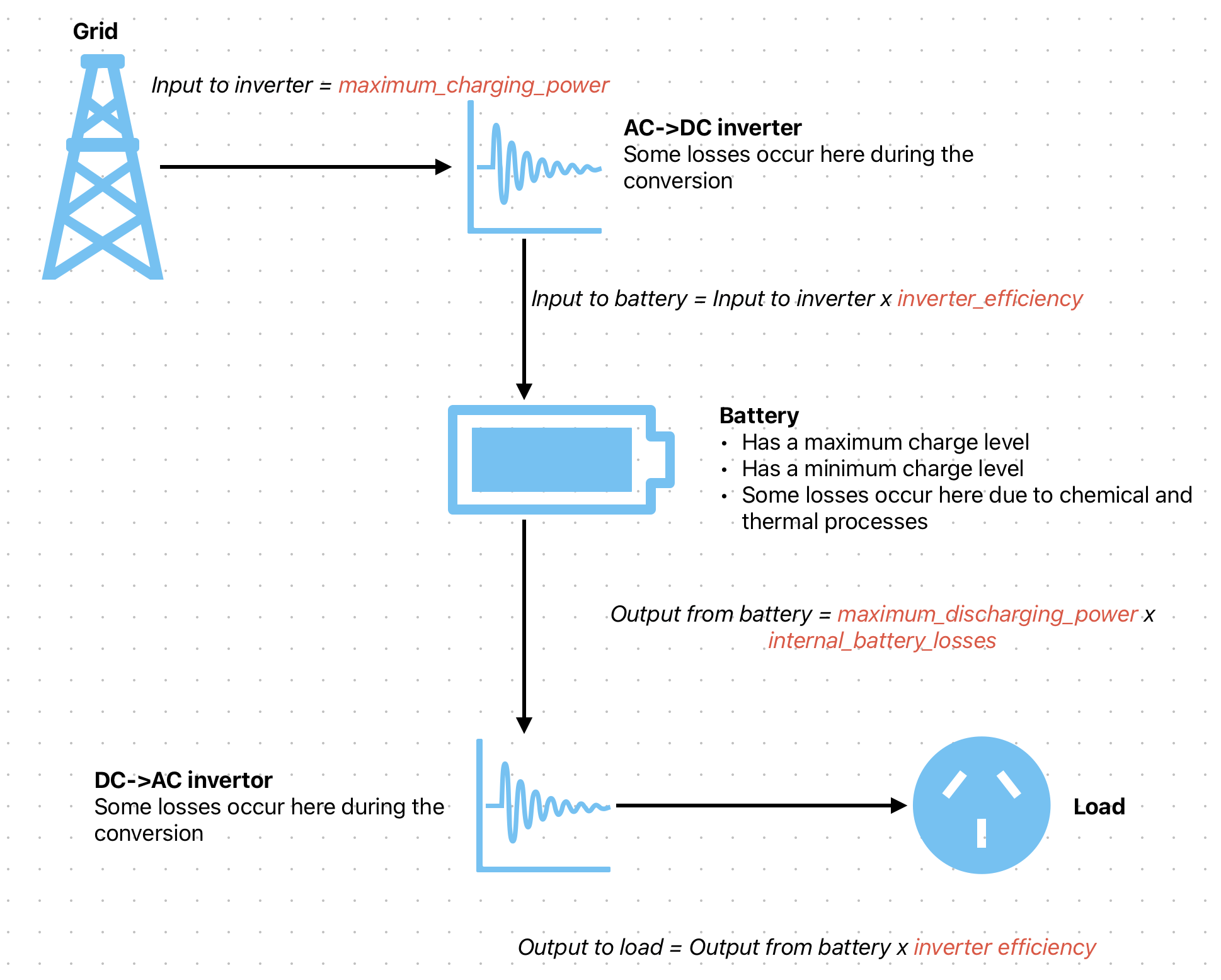
Fig. 1. Battery model schematic showing charging, discharging, and efficiency flows.
What this means for your forecast
Due to these energy losses, you will need to consume more electricity than you would without the battery. As a result, when comparing forecasts with a battery versus without one, you will notice higher electricity usage.
Limitations and Future Considerations
Capacity Fade:
This model does not account for long-term capacity degradation (capacity fade).
Over a ~2-year timeframe, degradation is expected to be only a few percent.
For longer-term simulations, capacity fade may be incorporated.
Configurable charge/discharge periods
When requesting a battery enabled load forecast you will be able to override the default charge and discharge periods. The default configuration will be set per jurisdiction.